Tame Your Inner Critic: 3 Steps to Steady Self-Trust

Dismantling the Inner Critic: A Practical Path from Harsh Self-Talk to Steadier Self-Trust
An inner critic can sound like “You’re not good enough” or “You always mess things up,” and it often shows up under stress, change, or comparison. The goal isn’t to force positivity—it’s to understand what the critic is trying to protect, loosen its grip, and replace automatic self-attacks with language that supports growth, boundaries, and resilience.
What the Inner Critic Really Is (and Why It’s So Convincing)
The inner critic usually isn’t “the real you.” It’s a learned strategy—often picked up in environments where criticism, high expectations, or emotional unpredictability were common. At some point, self-criticism may have seemed like a way to avoid rejection, mistakes, or disappointment.
What makes it persuasive is its style: urgency (“Fix this now”), certainty (“This will go badly”), and absolutes (“always,” “never,” “everyone”). That tone can feel like truth rather than a mental habit. In the short term, being hard on yourself can create a shaky sense of control—“If I push harder, I won’t mess up.” Over time, it typically increases anxiety and reduces follow-through.
The critic also wears “masks” that look productive on the surface: perfectionism, people-pleasing, procrastination, over-explaining, and harsh comparison. These can keep you busy while quietly shrinking your confidence.
How Negative Self-Talk Shapes Emotions, Body, and Behavior
Self-criticism tends to run a loop: thought → feeling → behavior. A critical thought triggers shame or fear, which leads to avoidance (or overworking), which then “proves” the critic right, creating more self-judgment.
Often, your body notices first. A tight chest, stomach drop, clenched jaw, or shallow breathing can show up before the words are fully conscious. When the critic is driving, motivation feels like fear—pressure, dread, or panic—rather than meaningful direction.
Common outcomes include playing small, withdrawing from relationships, working past the point of usefulness, or abandoning goals quickly after a setback. None of these mean you lack discipline; they often mean your nervous system is treating the moment like a threat.
Spotting the Critic in Real Time: Triggers, Scripts, and Patterns
Awareness is leverage. Start by mapping triggers: feedback, social media, deadlines, conflict, rest days, visibility (posting, presenting), or asking for help. Then capture your critic’s “signature phrases” verbatim. The exact wording matters because it reveals the fear underneath (rejection, humiliation, loss of control, being a burden).
It can help to identify the critic’s role:
- Protector: tries to avoid failure.
- Controller: demands perfection to feel safe.
- Judge: punishes to prevent “slacking.”
- Forecaster: catastrophizes to keep you on alert.
Instead of arguing with it, name it: “The Judge is here.” That simple label creates a pause and reduces fusion with the thought, making it easier to choose your next move.
A 3-Step Shift: From Self-Attack to Self-Leadership
Self-leadership doesn’t mean being soft or permissive. It means responding in a way that actually helps you recover, learn, and act.
Step 1 — Notice and label
Try: “This is self-criticism,” “This is a shame story,” or “This is an old rule.” The point is to recognize the pattern rather than treat it as a fact.
Step 2 — Validate the need underneath
Step 3 — Respond with a firm, kind alternative
| Inner critic script | What it’s trying to prevent | Coach response (firm + kind) |
|---|---|---|
| “You’re going to fail.” | Embarrassment, judgment, loss of control | “This is scary. Prepare the next step and ask for support where needed.” |
| “You should be over this by now.” | Feeling behind, fear of being flawed | “Healing isn’t linear. What support or rest helps today?” |
| “If it’s not perfect, don’t share it.” | Criticism and rejection | “Share a solid version. Improve with feedback instead of waiting for flawless.” |
| “You always mess up.” | Shame and helplessness | “One mistake doesn’t define you. What did this teach, and what’s the fix?” |
Quick Practices to Calm the Nervous System When the Critic Gets Loud
Building a New Inner Voice: Language That Creates Emotional Growth
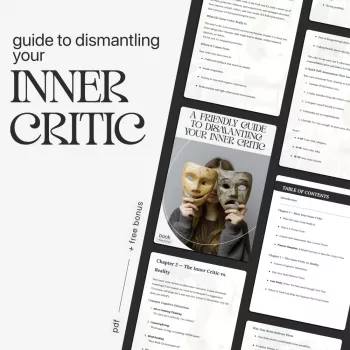
If you want structured exercises and scripts you can reuse, A Friendly Guide to Dismantling Your Inner Critic (digital eBook) offers a practical way to translate harsh self-talk into steadier, action-based support. For caregivers who want gentler language at home (especially during separation or big transitions), 10 Loving Ways to Comfort Your Child When They Miss a Parent can also help reinforce a calmer, kinder tone in everyday moments.
When Extra Support Helps
If self-criticism is linked with persistent anxiety, depression, trauma responses, or significant impairment in daily life, professional support can make a meaningful difference. Evidence-informed approaches that often help include cognitive behavioral strategies and acceptance-based approaches (see the American Psychological Association overview of CBT) and self-compassion training (resources from Kristin Neff, PhD). For broader guidance on caring for mental health, the National Institute of Mental Health is a reliable starting point.
FAQ
Why does my inner critic get louder when things are going well?
When progress increases visibility or change, the brain can interpret it as risk (more to lose, more to be judged). The critic may get louder as a “prevention strategy,” trying to keep you small so nothing goes wrong. Notice it, validate the fear underneath, then respond with one practical next step that supports your values.
How do I stop negative self-talk without forcing fake positivity?
Use neutral, accurate language: name the facts, name the feeling, name the need, and choose a next step. Compassion can coexist with accountability—kindness sets the conditions for learning, and clarity keeps you moving.
How long does it take to change an inner critic pattern?
Many people notice early shifts in weeks, with steadier change over months as new responses become more automatic. Consistency matters more than intensity, especially practicing during low-stress moments and tracking small wins.













Leave a comment