AI Reframing Routine to Rewrite Unhelpful Thoughts

Using AI to Transform Unhelpful Thoughts: A Practical Reframing Routine You Can Repeat
Unhelpful thoughts can feel convincing, especially when stress is high or confidence is low. A simple, repeatable process can interrupt the spiral: identify the thought, test it, and rewrite it into something accurate and supportive. AI can speed up that process by offering alternative perspectives, gentler wording, and structured questions—while still keeping the final voice and values firmly human.
What “unhelpful thoughts” look like in daily life
Unhelpful thoughts usually follow recognizable patterns. They often sound certain, sweeping, and personal—like a verdict instead of a hypothesis. Common examples include all-or-nothing thinking (“If it isn’t perfect, it’s a failure”), mind reading (“They’re disappointed in me”), catastrophizing (“This will ruin everything”), overgeneralizing (“This always happens”), labeling (“I’m incompetent”), and discounting positives (“That doesn’t count”).
These thought loops don’t just feel bad; they shape behavior. A harsh thought can lead to avoidance and procrastination (“Why start if I’ll mess it up?”), irritability (“I’m already failing, so why try to be nice?”), people-pleasing (“If they’re mad, I need to fix it now”), or subtle self-sabotage (“I’ll skip the meeting because I’ll look stupid”).
A helpful goal isn’t forced positivity. It’s replacing harsh certainty with balanced accuracy—language that’s kind and realistic, without pretending everything is fine. One fast checkpoint: notice body cues as an early warning sign. Tight chest, racing heart, clenched jaw, and shallow breathing often appear before the thought becomes a full spiral.
Why AI can help with mindset reframing (and where it can’t)
AI is useful for generating options quickly, mirroring your words back so you can evaluate them, identifying likely cognitive distortions, and offering neutral phrasing when emotions are loud. It can also help structure a worksheet-style routine when your brain feels scattered.
AI is not a therapist. It cannot diagnose, provide crisis support, or replace professional care. Reframing works best as collaboration: AI proposes drafts; you select what feels true, edit the wording, and confirm it aligns with your values and real-life context.
For privacy, keep examples generic when possible and avoid sharing identifying details (names, addresses, workplace specifics, or anything sensitive). If you want to understand cognitive distortions more deeply, the American Psychological Association’s definition of cognitive distortion is a helpful reference.
| Situation | AI-assisted reframing can help | Consider professional support |
|---|---|---|
| Everyday stress, self-criticism, work worries | Yes—generate balanced statements and action steps | If symptoms are persistent or worsening |
| Anxiety spirals that calm with structure | Yes—use a repeatable worksheet-style routine | If panic attacks or avoidance significantly disrupt life |
| Trauma-related memories or intense triggers | Sometimes—only for gentle grounding language | Yes—trauma-informed therapy recommended |
| Thoughts of self-harm or feeling unsafe | No—do not rely on AI | Immediate help via local emergency services or crisis resources |
A 6-step AI-assisted reframing routine
This routine is designed to be repeatable, fast, and practical—even on a busy day.
Step 1: Capture the thought verbatim
Step 2: Label the situation and emotion
Step 3: Identify the thinking trap
Step 4: Ask for evidence on both sides
Step 5: Rewrite into a balanced thought
Step 6: Choose a tiny next step
| Original thought | Balanced rewrite | Tiny next step |
|---|---|---|
| “I always mess things up.” | “I made a mistake, but I also complete many tasks well. I can fix this one step at a time.” | List 2 fixes; do the easiest in 5 minutes |
| “They haven’t replied—they must be mad.” | “There are many reasons for no reply. If I need clarity, I can ask directly.” | Send one neutral follow-up message |
| “If I don’t do it perfectly, it’s pointless.” | “Progress counts even when it’s imperfect. A draft is better than nothing.” | Work for 10 minutes; stop when timer ends |
Ready-to-use AI requests for rewriting thoughts
Keeping the rewritten thought believable (so it actually works)
A simple weekly practice plan (5 minutes a day)
Digital guide for structured reframing with AI
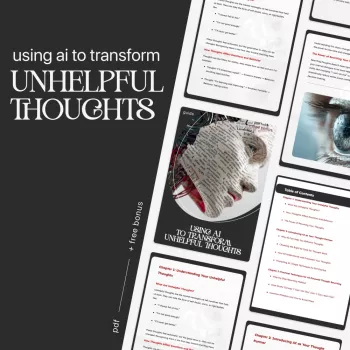
A guided format reduces friction by giving you repeatable templates for capturing thoughts, labeling patterns, and rewriting with clarity. For a structured, reuse-friendly system, explore Using AI to Transform Unhelpful Thoughts (digital guide), designed to support journaling, coaching-style reflection, and consistency during busy weeks.
Reframing can also be useful when parenting emotions run high—especially during transitions and separations. If a child is struggling with missing a parent, 10 Loving Ways to Comfort Your Child When They Miss a Parent (printable checklist) offers gentle, practical steps that pair well with calmer self-talk and boundary-friendly communication.
For more background on evidence-based talk therapies, review the National Institute of Mental Health overview of psychotherapies and the NHS guide to CBT.
FAQ
Is AI-based reframing the same as cognitive behavioral therapy?
It overlaps with CBT-style skills like spotting distortions and testing evidence, but it isn’t therapy. AI tools can support practice and structure, while professional care is best for diagnosis, treatment planning, and complex or severe symptoms.
What if the rewritten thought feels fake or overly positive?
Make it more specific and evidence-based, and soften certainty with “maybe” or “sometimes.” Try multiple rewrites and keep the one that feels believable and lowers the emotion intensity even a little.
Can this help with anxiety spirals at night?
Yes: write the thought, label the fear and intensity, generate one balanced rewrite, add a simple coping plan for tomorrow, then do one calming action (slow breathing, a short body scan, or dimming screens). If distress feels severe or safety is at risk, seek immediate help through local emergency services or crisis resources.















Leave a comment