Printable Night Routine Checklist for Sleep & Anxiety
Why a checklist can make nights feel easier
When sleep feels fragile, the hardest part is often the in-between time: the minutes when you’re tired, but your mind keeps asking, “What should I do now?” A printable checklist turns that moment into a simple sequence you can follow without negotiating with yourself.
- Reduces mental load: fewer decisions means fewer chances to spiral into “I’m doing bedtime wrong.”
- Builds consistency: repeated cues teach your brain that sleep is coming, so winding down starts sooner.
- Supports anxious minds: gentle structure helps when thoughts feel scattered or loud.
- Makes progress visible: checking off small steps can lower stress and increase a sense of control.
- Stays realistic: you can shorten the routine on hard nights without scrapping it entirely.
Set the stage: a 10-minute “sleep environment reset”
Before you try to calm the mind, make the space feel safer and quieter. Think of this as lowering the volume on the room so your nervous system doesn’t have to work as hard.
- Dim lights 60–90 minutes before bed when possible, and avoid bright overhead lighting.
- Lower stimulation: silence non-urgent notifications and put your phone on charge outside the bed area if feasible.
- Make the room comfortable: aim for cool, dark, and quiet; consider a fan or white noise if sound is a trigger.
- Prep small comforts: water, lip balm, tissues—anything that prevents “one more trip” cycles.
- Use one consistent calming cue: the same scent, lamp, or playlist can become a strong wind-down signal over time.
If you want a quick refresher on healthy sleep basics, the NHLBI overview of healthy sleep and the CDC sleep resources are solid starting points.
Simple steps to ease anxiety before bed (choose 3–5)
You don’t need a perfect, hour-long routine. Pick a handful of steps that reliably reduce tension. Rotate them as needed, but keep the order mostly the same so your body recognizes the pattern.
- Worry offload (2–5 minutes): write down looping thoughts, then add one next step or a “not tonight” note.
- Body scan check-in: notice jaw, shoulders, belly, hands—soften each area on an exhale.
- Breathing pattern: inhale for 4, exhale for 6 for 2–4 minutes to encourage a calmer state.
- Gentle stretch: neck rolls, a forward fold, or legs-up-the-wall for 2–5 minutes if comfortable.
- Warm rinse or shower: warmth often helps the transition into rest.
- Caffeine/alcohol reality check: if sleep is fragile, try earlier cutoffs for a week and track changes.
For more context on how anxiety can show up in the body and mind, the APA’s anxiety guide is a helpful reference.
A short meditation routine for sleep and anxiety (5–12 minutes)
This is meant to be doable, not impressive. A shorter practice you’ll actually repeat is more useful than a long session you avoid when you’re anxious.
- Set a timer: keep it short enough to feel manageable on tense nights.
- Posture: lie down or sit supported; let the body feel heavy.
- Anchor: choose breath, a calming word (“calm”), or a steady sound (fan/white noise).
- When thoughts surge: label softly (“thinking,” “planning,” “remembering”), then return to the anchor without debating the thought.
- Closing phrase: “Nothing to solve tonight. Rest is the task.”
- If you wake at night: repeat a 1–3 minute version rather than reaching for your phone.
Printable night routine checklist: a sample flow (adjust to fit real life)
The goal is a predictable runway into sleep. Order matters more than completing every step. Many people do best with two versions: a “full” routine for normal evenings and a “minimum” routine for nights when energy is low.
| Time | Step | Goal | Minimum version |
|---|---|---|---|
| 60–45 min | Dim lights + set phone to Do Not Disturb | Lower stimulation | Dim one lamp + DND |
| 45–30 min | Quick tidy + prep tomorrow (2 items only) | Reduce morning stress | Prep 1 item |
| 30–20 min | Wash face/brush teeth + change clothes | Transition cue | Basics only |
| 20–10 min | Worry offload + gratitude (1 line) | Clear mental clutter | Write 3 bullets |
| 10–5 min | Breathing (4 in / 6 out) | Downshift arousal | 60 seconds |
| 5–0 min | Short meditation or body scan | Settle attention | 3 breaths + phrase |
When sleep still doesn’t come: what to do at 2 a.m.
Make it stick: small habit tips that reduce friction
Download option: Find Your Calm Checklist
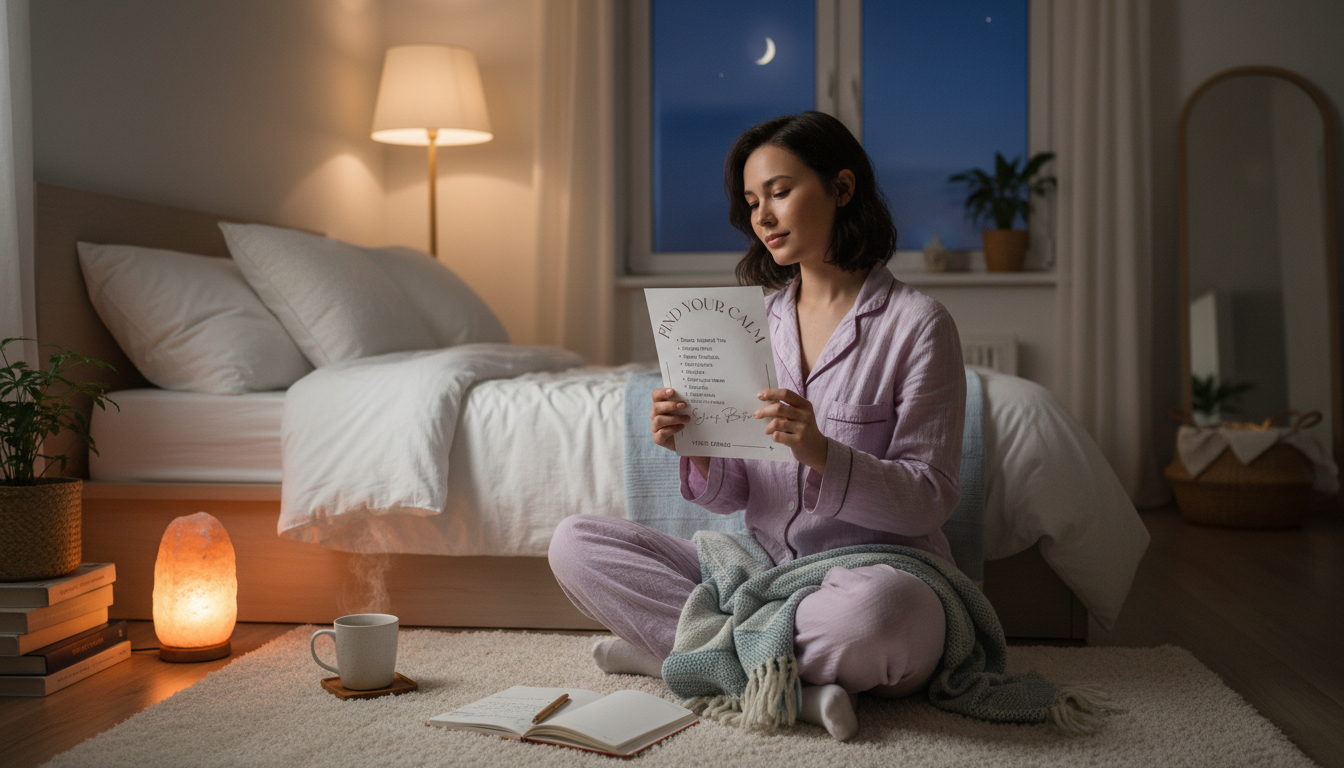
If you’d like a ready-made printable you can use nightly (or pull out during stressful weeks), the Find Your Calm Checklist: Simple Steps to Sleep Better and Ease Anxiety is designed for simple, repeatable steps that reduce decision fatigue.
If nighttime anxiety is tied to family transitions or separation worries in the home, the 10 Loving Ways to Comfort Your Child When They Miss a Parent checklist can support calmer evenings with practical, reassuring steps.
FAQ
How long should a night routine be to help anxiety and sleep?
Aim for about 10–45 minutes, depending on your schedule and what truly helps you settle. Consistency matters more than length, so having a “minimum routine” (even 3–5 minutes) keeps the pattern intact on hard nights.
What if meditation makes anxiety feel louder at bedtime?
That can happen when attention turns inward and you notice sensations or thoughts more clearly. Try shorter sessions, keep your eyes open, focus on sound (like a fan), or use a body-based anchor such as slow exhaling; if you experience panic symptoms, professional support can help tailor safer strategies.
Is it okay to use the checklist even if sleep schedules are irregular?
Yes—use a consistent sequence rather than a fixed clock time. Keep the first steps portable (dim lights, offload worries, 3-minute breathing) so the routine still signals “wind down” even when bedtime shifts.
















Leave a comment